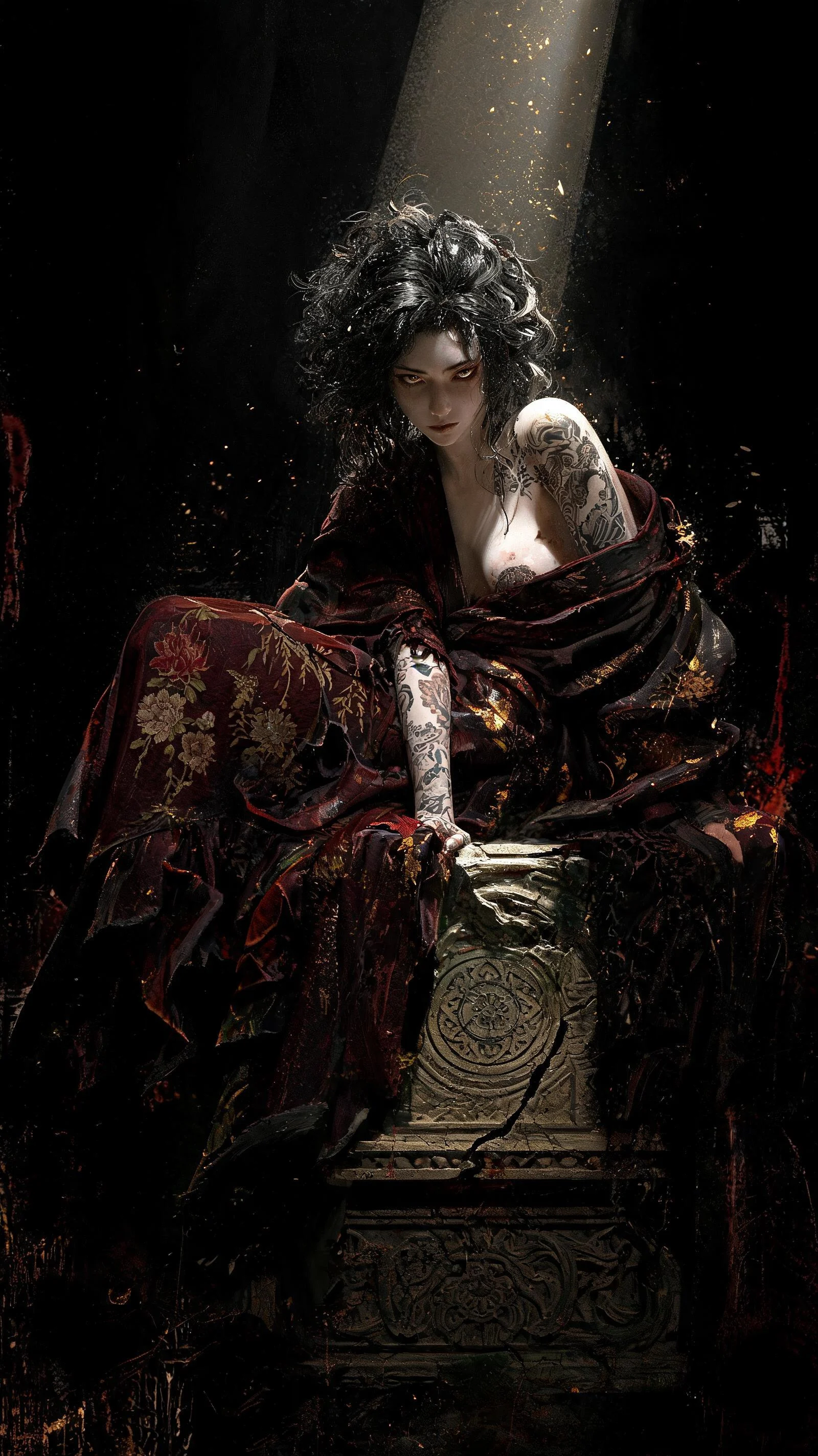
Visual Style:A masterpiece of High-Baroque Tenebrism, reminiscent of a haunting, sacrilegious commission by Caravaggio or Artemisia Gentileschi. The aesthetic is defined by extreme chiaroscuro, where subjects emerge from an absolute, ink-black void into a singular, violent shaft of theatrical light. The texture is hyper-emphasized: thick, buttery impasto strokes create a 3D physical relief on the canvas, featuring heavy craquelure (cracked paint) and visible, aggressive brushwork. The color palette is a "bruised" spectrum—deep oxblood, oxidized copper green, scorched umber, and flecks of crumbling gold leaf that seem to flake off the surface. Every highlight is a sharp, brilliant strike of white-gold light, while every shadow is a dense, suffocating space where detail is swallowed by darkness.Subject Description:A spectral, porcelain-skinned woman sits enthroned in a position of agonizing grace within a desecrated sanctuary. Her hair is a chaotic storm of obsidian curls and silver threads, rendered with such thick paint it appears to have physical weight and movement. She wears a tattered, heavy silk kimono that hangs in jagged, sculptural folds; the fabric is weighed down by dying embroidery of withered peonies and weeping willow branches. Her arms are a canvas of "living" ink—traditional irezumi tattoos that appear to pulse with a dull, subterranean light under her skin. She holds a steady, terrifyingly intimate gaze, her eyes reflecting an ancient, forbidden knowledge. The background is a crumbling altar of cracked stone, where a massive, decaying mandala is carved into the masonry. Suspended in the air are particles of dust and drifting ash, caught in the harsh light like tiny stars, creating a sense of stagnant, holy silence.
Visual Style:A masterpiece of High-Baroque Tenebrism, reminiscent of a haunting, sacrilegious commission by Caravaggio or Artemisia Gentileschi. The aesthetic is defined by extreme chiaroscuro, where subjects emerge from an absolute, ink-black void into a singular, violent shaft of theatrical light. The texture is hyper-emphasized: thick, buttery impasto strokes create a 3D physical relief on the canvas, featuring heavy craquelure (cracked paint) and visible, aggressive brushwork. The color palette is a "bruised" spectrum—deep oxblood, oxidized copper green, scorched umber, and flecks of crumbling gold leaf that seem to flake off the surface. Every highlight is a sharp, brilliant strike of white-gold light, while every shadow is a dense, suffocating space where detail is swallowed by darkness.Subject Description:A spectral, porcelain-skinned woman sits enthroned in a position of agonizing grace within a desecrated sanctuary. Her hair is a chaotic storm of obsidian curls and silver threads, rendered with such thick paint it appears to have physical weight and movement. She wears a tattered, heavy silk kimono that hangs in jagged, sculptural folds; the fabric is weighed down by dying embroidery of withered peonies and weeping willow branches. Her arms are a canvas of "living" ink—traditional irezumi tattoos that appear to pulse with a dull, subterranean light under her skin. She holds a steady, terrifyingly intimate gaze, her eyes reflecting an ancient, forbidden knowledge. The background is a crumbling altar of cracked stone, where a massive, decaying mandala is carved into the masonry. Suspended in the air are particles of dust and drifting ash, caught in the harsh light like tiny stars, creating a sense of stagnant, holy silence.